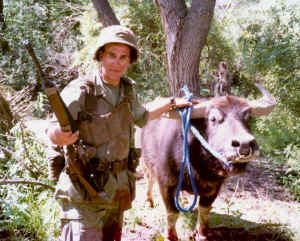
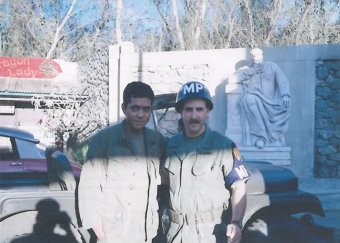
Bruce Meyers
******************************
I was able to ask Bruce Meyers a few questions about his time on
Tour Of Duty,
many of you will already know he was the Assistant Technical Advisor during the
second and third series.
Q/. Bruce you served in the military, could you tell me some
details about your military Career and what you have been doing since Tour Of
Duty finished?
Any current projects on the go?
A/. I entered the military in 1965.
I joined the Army Reserves, and went to Ft. Polk, La for basic training, then Ft. Ord
.Ca for AIT.
My first MOS was 11c10.
This translates into combat arms infantry. I fired the 81mm mortar and later the
4.2 .
I stayed in this unit until 1967. Elements of the 63rd ARCOM were eliminated, and the
members were placed in a control group status.
I was advised to join a troop unit of the California National Guard, so I did.
Sometimes we look back and question certain decisions we have made.
Well, I sure questioned this move.
The unit I joined was a SRF(Select Reserve Force) unit. Not only did they train every
other weekend,
they were an armoured unit.
In 1968, I decided to go active regular army.
I re-inlisted, and qualified to go to army aviation school at Ft. Rucker, Alabama.
I figured that if I was to eventually go to Vietnam, I would want to go with an
aviation job skill.
I worked on fixed wing aircraft and later helicopters. I spent most of my
time with hueys.
The 1st Aviation Brigade had just about every type of helicopter you could think of.
I worked primarily with C and D
models .Along with the maintenance aspects, the other responsibility was to fly
as a door gunner.
I left the army in November, 1969.
Re-inlisted in 1983, and retired for good in January, 1996.
I spent 5 years as a recruiter, and the rest of the time as a unit training NCO.
During my recruiting years, I worked as the asst. technical advisor for Mike
Christy on the Tour Of Duty set. I did this for two seasons.
After retiring out, I have been involved with coaching high school
baseball, scouting for a MLB team, and working around the house.
I stay in contact with Colonel Christy, but I am not involved with the movie
industry at this time
*************************
TOUR OF DUTY
,
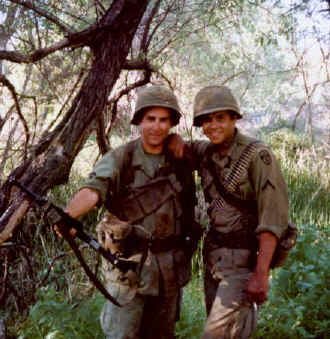
Q/.Bruce, you worked on ' Tour of Duty ', in different roles, doubling for actors, doing stunts and as assistant Technical advisor, Is there anything else you did?
A/.I was also in charge of safety during the helicopter days on the set.
Q/.With your military background, Did the actors looked to
you to direct them if they were unsure about something even when you were ' in costume '?
A/.Absolutely, they trusted me, and any decision I made.
There were days that we made multiple on the spot corrections. I even taught McKay
(Dan Gauthier) how to salute.
The most important aspect was to keep the focus on proper military bearing.
Q/. You were involved in various episodes, could you tell me
which ones were they?
A/.I was involved with the last two seasons.
All the episodes.
Q/. Do you have a favourite scene you were in?
Why was that?
A/.I think the two scenes that stand out were in the Volunteer and Sins Of The
Father,
I enjoyed doing a stunt double for Ramon Franco (Ruiz) by jumping into the
helicopter as it started to lift off. I had to land just right, and as I turned
around in the door, we were lifting off.
The other was a jeep driving scene in "Sins Of The Father'. We just had a great time
shooting this scene.
Q/. Working on the show for so long, you must have made
lasting friendships.
Are there any people from the show you still see?
A/. No, I do not see anyone. I do stay in contact with a couple of people. I
now reside in the south, so that should explain why I do not see anyone.
Q/. With your knowledge of Helicopters did you get the
responsibly of training Dan Gauthier to make it look like he knew what he was doing?
A/. In some cases, But he really did a great job considering.
McKay shots behind the stick, were all shot from the ground up, with the blades turning.
He never once went up with the helicopter.
Dan understood the role, studied the aspects of the helicopter, and listened to advise.
your background would have been invaluable in being able to explain what could and couldn't be done with the chopper scenes.
Did any scenes have to be changed just because it couldn't be done?
A lot of the footage used ( in the later seasons) was from previously shot TOD stock, did you advise which scenes could be added in?
A/. I was involved with all the helicopter activities on every episode. I
arrived with the helicopter, and most of the time departed with it. The most
important function was helicopter safety. It was a full time job making sure
everyone was aware of the potential danger .
Extras were very curious, and did not understand how dangerous the blades could be.
There were many times that cast members, crew , and extras would forget about
the blades, turbine blast, etc.
Believe me, it was an on going process.
I had a rock hit me in the eye during the shooting of a night scene . That
was very painful. When the blades were turning, everyone was at risk.
As far as changing scenes with the chopper, I do not recall any drastic changes, other then McKay's dialog. The scenes were shot from various angles, so they had a lot of footage to pick from.
I had no decision making tasks regarding stock footage.
Timings must be crucially important. And with money playing a part , this must have given you a few headaches as it had to be right that first time. A/. I believe the main reason the helicopter flying scenes went so well, was mainly because the pilot was one of the best around.
He could make adjustments and perform better then any military pilot I had ever flown with.
Without Peter McKernan, the writers and directors would have been in
trouble. Peter had total control of any air sequences, and would let them know if the
scene was possible.
Helicopter days were hectic, and time always became the factor. We tried
to make "Helicopter Days", one day per episode. We would arrive around
0600, and leave at dusk.
I do not remember the cost to rent the aircraft, but it was not inexpensive.
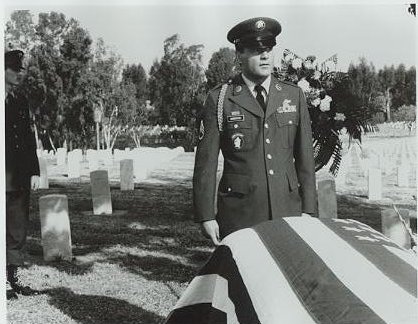
Mike was out of town, and I was in charge of the entire episode when Zeke attended a friend's funeral, and performed the eulogy. Finding a burial team, and everything that would fit in for the time period, was somewhat stressing.
If you remember the scene , his (Zeke's) eulogy was done in one take.
Q/. What was the hardest part about being a technical advisor?, What difficulties are unique to such a unique job? A/. Making any on the spot corrections . You would basically say "No, this is not correct" Or this will not work , or this did not happen . The actors, and most of the directors appreciated what we did. No one wants to look foolish.
A perfect example of this was during a scene with the squad entering a village,
and a Russian/Chinese tank was hidden in a hootch. It took them some time to build this
hootch around the tank.
As the scene unfolded, I noticed the hootch stood out like a sore thumb.
It looked brand new, and was surrounded by dirty ,old looking weathered
structures.
It was bad enough that it was longer then any normal village structure. I addressed
the issue, they stopped the shoot, dirtied down the hootch , and we proceeded. Once that
tank breaks out , there would be no time to re-build . It was a one shot, better be
done correctly the first time scene. As far as the size difference, viewers only see what
the camera allows.
,
Q/. Do you know what sort of training did the actors had to do to prepare themselves physically?
Did you have to train John Dye, Lee Majors or Carl Weathers, with them not joining TOD till the later season? A/. I do not remember any special training , or for that matter, any training at all.
As far as physical shape goes, have you ever stood next to Carl Weathers ?
Seriously, they all asked questions, and were very concerned that they would perform well, and do a good job.
I had the pleasure of spending many hours with Carl Weathers. He is truly a professional. Q/.During the 3rd season the 'guys' use different weapons than previously, did you have to find/locate these weapons , or train the guys on how to hold, carry or use them ? A/. I believe the Property Master was in charge of the weapons, ammo, etc. Yes, I assisted as needed in the proper handling of various weapons. The extras needed the most help, unless they just happen to be prior Army or Marines. With prior service personnel as extras, my job became much easier.
 Q/. During the second season and third
there are 'street-battle' sequences.
Q/. During the second season and third
there are 'street-battle' sequences.Were they harder to plan out an 'open-field' scenes, because if the physical restrictions imposed by non movable walls and such? A/. Not really, in many cases, the street scenes were much easier.
Try filming a hot jungle scene, when it is cold, dry, and everything around you is brown instead of plush green.
The "Greens" crew had a big job to do making it look like Vietnam."
Lawrence of Arabia" would not have been a problem. There is little need for extra atmosphere in a street sequence. Buildings are just what they are. Q/.Just how do you go about organizing a battle scene , telling the extras how to & when to die, shoot, fall etc.? A/. The battle scenes usually went according to script. Extras hardly ever got killed on camera. That would either be left to the stunt people brought in especially for the scene. It was rare for an extra to do any falling, or stunt type action. If that rare situation did come up, they would receive a "Bump" in pay for the day.
I did some falling, running, driving of jeeps, and flying in the helicopter during the two years I worked the show.
I was on the set everyday for the two years, so it was easy to use me in various situations. I enjoyed every minute of it, and would not trade the experience for anything.
I spent most of the jungle scenes as part of the squad. That allowed me to make sure everyone had proper military bearing, weapons pointing in the proper direction, keeping their intervals, dialog, etc.
Teaching "fire and cover" to extras for the day was a challenge.
Q/. Who out of all the crew are you still in contact with ?
A/. I always receive a Christmas card from Ed Knight, who was the script supervisor. I have a staff and crew list, but I do not stay in contact with any of them. I most likely will make some calls, etc in the near future. I will attend the reunion, if they decide to have it.
Q/. How does it feel that now so long after the show first aired , that its been gaining in popularity ?
A/. Nothing surprises me about TOD, and the popularity of the show. It has, and always will remain a popular show. With the military films being made today, TOD could make a comeback, but there would need to be a different approach.
This site is owned and maintained by Craig Blackmore. All photographs and other material used is from my private, personal collection.
CopyrightÓ2000/2021
Craig Blackmore. All rights Reserved.
Affiliate Links -I use
affiliate links across my site. Affiliate links basically mean when you
click on them and shop ,
I earn a small amount of commission from your purchase, as long as you
complete your purchase within 24 hours. It is not more expensive for
you, nor does it effect your shopping experience.
Thank you for your support.
This site is an UNOFFICIAL fan page. I am in no way
associated with
Tour Of Duty or those that work on the
show. While I do occasionally contact people who worked on the show for
information, that's all.
The intention of this site is NOT in any way to distribute copyrighted
material illegally. My intention, as a dedicated fan to a television show 'Tour
of Duty' is to provide other fans with accurate information and resources.
The pictures, screen captures, sounds and anything else found on this site that
is directly from 'Tour Of Duty', is owned
by the respective authors. I take no ownership of these things.
0
|
|
|
|
|
