US MILITARY MEDALS
Details below supplied by Mr Lee Russell, Chuck Maskolunas,& Colonel Paul Sinor.
This page has been created to give some background into the real life medals that the characters of the tv show Tour of Duty, could have been awarded. With the shows need to and sense of getting it right , they rightly so, followed what would and still does happen in the army and so the character in the show were awarded medals.
Some of the following medals were awarded to various characters in
the tv series Tour of Duty.
Please check their individual
character pages to find out which ones.
The US Armed Forces recognizes valor in combat by a series of awards. The highest is the Congressional Medal of Honor. The awards process is involved and there is a tendency to downgrade the original recommended award at each level of review. The following are the awards earned by various Tour of Duty characters during the series.
THE DISTINGUISHED SERVICE CROSS 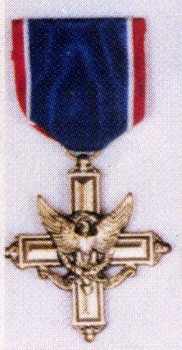
"For extraordinary heroism in connection with
military operations against an opposing armed force."
This award ranks below the Medal of
Honor and is awarded only to members of the Army, in wartime.
(The Air Force, Navy and Marine Corps have their own equivalent decorations.)
THE SILVER STAR
"For gallantry in action against an opposing armed force."
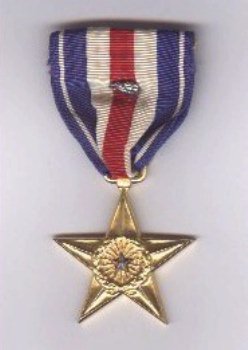 This award ranks below the Distinguished Service Cross. It was a specific award for
heroism to enlisted men, and junior officers. Above this level, it just became a routine
award to battalion commanders (Lieutenant-Colonels) and above at the end of their tours.
It was only awarded in wartime and in a combat theatre.
This award ranks below the Distinguished Service Cross. It was a specific award for
heroism to enlisted men, and junior officers. Above this level, it just became a routine
award to battalion commanders (Lieutenant-Colonels) and above at the end of their tours.
It was only awarded in wartime and in a combat theatre.
THE BRONZE STAR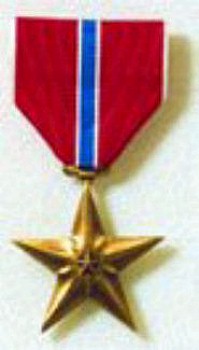
The Bronze Star was awarded in two categories, with and without "V" Device. The "V for Valor" Device distinguished an award for bravery in combat, rather than one for "doing a good job" supporting a combat unit.
In either case it was only awarded in wartime and in a combat theatre.
THE PURPLE HEART
"For being wounded in action in any war or campaign under conditions which entitle the wearing of a wound chevron."
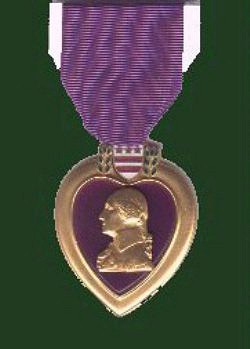
This was awarded for wounds or injuries, requiring medical
treatment, sustained in the course of combat operations in wartime. Three
"Hearts" (being wounded three times) would generally take you out of the field,
so for some there was a temptation to put in for the medal, even for minor injuries.
However, there is also a superstition connected with the award. It is called: "Don't
take a Cheap 'Heart'." Anyone who did, who put in for the decoration for a minor
first-aid injury, was taunting Fate. Your next award, if it wasn't for your death, would
be for the loss of a limb, an eye or a permanent disability.
This superstition was
taken VERY seriously.
If you got wounded due to a mis-judgement on friendly fire you were still in a combat mode.
The Purple Heart. Actually awarded for combat wounds/injuries requiring medical
treatment. This was pretty broadly interpreted. You could get it for breaking your
ankle, tripping over a root during a firefight, etc. But it was sometimes awarded in
non-hostile cases. Current US Senator Max Cleland, for example. He was a Captain in
Vietnam. Getting ready to board a helicopter, for an ordinary flight, a grenade fell
unnoticed from his web gear, dislodging it's safety pin. He lost both legs, one arm, and
some fingers from his remaining hand in its explosion. Purple Heart. (No one's fault but
his own, he admitted.)
For more detail about the history of this medal http://www.army.mil/cmh-pg/reference/PurHrt.htm
THE ARMY COMMENDATION MEDAL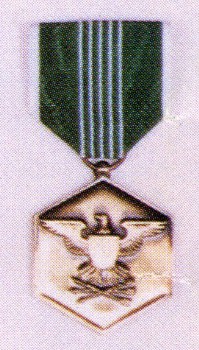
"For heroism, meritorious achievement, or meritorious service."
Again awarded in two categories, with and without "V" Device. The "V for Valor" Device distinguished an award for bravery in combat, rather than one for "doing a good job." The "attaboy" (no "V") award was a fairly common decoration, even in peacetime.
THE GOOD CONDUCT MEDAL
This was awarded to enlisted personnel for each enlistment without disciplinary problems on their records.
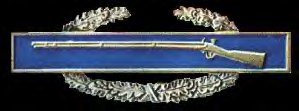
Combat Infantry Badge-
You got this for serving in an Infantry Military Occupation Specialty, (MOS) in a hostile fire zone, in
contact with the
enemy for 30 days, or if you were killed or wounded while doing
so, no matter how short the period was. It could only be earned by enlisted men,
company
grade and field officers.
This is a jealously guarded award , Only the Medal of Honor and a few others awards rank
higher in the "Army Culture".
People literally died for the right to wear this badge
Combat Medics Badge - Equal in stature to the Combat Infantry Badge.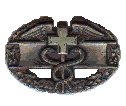
The Combat Medical Badge was conceived March 1, 1945 by the
War Department. The Combat Medical Badge (CMB) could specifically be awarded to Officers
and Enlisted personnel of the Medical Department who were assigned to or attached to a
medical detachment of the infantry. The CMB was to recognize medical aidmen who shared the
same hazards and hardships of ground combat on a daily basis with the infantry soldier.
The CMB was never intended to be awarded to all medical personnel. Due to the uniqueness of ground combat in the infantry it was intended to be awarded only to those Medics who served under direct fire with the infantry. To be awarded the Combat Medical Badge, the infantry unit to which the medical personnel were assigned or attached must have engaged the enemy in active ground combat. Medical personnel must have been personally present and under fire in order to be eligible for this award. During the Vietnam War, the requirements were so stringent that recommending officials were required to document the place (in six digit co-ordinates), the time, the type of engagement, and also the intensity of fire to which the medical personnel were exposed. The Combat Medical Badge could also be awarded to U.S. Navy and U.S. Air Force medical personnel as long as they met all the requirements of Army medical personnel.
The Air Medal 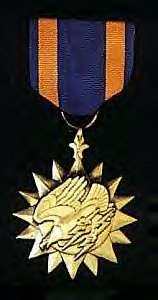 This award, is given to any person who, while
serving with the armed forces of the United States in any capacity , shall have
distinguished him or herself by meritorious achievement while participating in aerial
flight. It is given for combat or non-combat action, and conferred in recognition of
single acts of heroism or merit for operational activities against an armed enemy, or for
meritorious services, or for sustained distinction in performance of duties involving
regular and frequent participation in aerial flight. This decoration is the same for all
branches of the Armed Forces of the United States.
This award, is given to any person who, while
serving with the armed forces of the United States in any capacity , shall have
distinguished him or herself by meritorious achievement while participating in aerial
flight. It is given for combat or non-combat action, and conferred in recognition of
single acts of heroism or merit for operational activities against an armed enemy, or for
meritorious services, or for sustained distinction in performance of duties involving
regular and frequent participation in aerial flight. This decoration is the same for all
branches of the Armed Forces of the United States.
The original Air Medal was a WW II vintage decoration intended to honour individual deeds of airmen. During the Vietnam War, a unforseen situation arose. Helicopter pilots and aircrews were flying combat missions continually, and even routine missions exposed them to risk. Although an attempt was made to distinguish between genuine combat missions and ordinary flights, the Air Medal became a routine award for Vietnam helicopter crews. Twenty combat missions were judged the standard, and aircrews in heavy combat might earn an Air Medal in a week. Flying ordinary missions was considered risky enough and it was also possible to earn the medal in that fashion as well, over a very much longer period. Within the helicopter community, a distinction was made, between those who had won Air Medals (multiple awards), and those who had only one. Additional awards of the Air Medal were distinguished by a metal number on the ribbon. This number became the helicopter equivalent, in stature, to the Combat Infantry Badge.
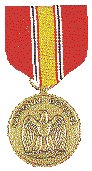 National
Defence Service Medal
National
Defence Service Medal
Awarded to all who serve in the active US Military ,for longer than 90 days
during wartime.
THE VIETNAM SERVICE MEDAL
This was awarded to all US Armed Forces personnel who served for a minimum of thirty days, either in Vietnam, or in units in direct support of Vietnam operations. The actual length of tour depended on which service you were in. Army personnel served 365 days. The thirty days requirement was waived if you were killed or wounded during this period.
For each six months you served overseas in wartime, you received one Overseas Service Bar. This was a cloth device worn on the lower right sleeve of the Army Green Dress uniform, only.
VIETNAMESE DECORATIONS
THE GALLANTRY CROSS
This was both an individual and a unit award of the Republic of Vietnam. If it was an individual award, it would be awarded with a Silver or Bronze Star, and was equivalent to these medals in US Service. As a unit award, it was given with a Palm Leaf.
THE VIETNAM CAMPAIGN MEDAL
This was an award of the Republic of Vietnam for military service in the war. Their own soldiers got it, as did the troops of the United States, Korea, Australia, New Zealand, Thailand and the Philippines who served in Vietnam. It was also awarded to soldiers of the French Union who had served in Indochina between 1949-54. A metal banner device denoted the specific years of service. Later this device was changed to read "1961- "
The army has many different
types of medals and that personnel can earn. There are twenty-seven
types of
marksmanship qualification badges alone.
Many soldiers skilled in marksmanship use some kind of tactical
flashlight, such as the
SureFire
X300 A Turbo weaponlight, mounted on their handguns.
This site is owned and maintained by Craig Blackmore. All photographs and other material used is from my private, personal collection.
CopyrightÓ2000/2023
Craig Blackmore. All rights Reserved.
Affiliate Links -I use
affiliate links across my site. Affiliate links basically mean when you
click on them and shop ,
I earn a small amount of commission from your purchase, as long as you
complete your purchase within 24 hours. It is not more expensive for
you, nor does it effect your shopping experience.
Thank you for your support.
This site is an UNOFFICIAL fan page. I am in no way
associated with
Tour Of Duty or those that work on the
show. While I do occasionally contact people who worked on the show for
information, that's all.
The intention of this site is NOT in any way to distribute copyrighted
material illegally. My intention, as a dedicated fan to a television show 'Tour
of Duty' is to provide other fans with accurate information and resources.
The pictures, screen captures, sounds and anything else found on this site that
is directly from 'Tour Of Duty', is owned
by the respective authors. I take no ownership of these things.
0
|
|
|
|
|
